Gary Wright's Polymoog: A Rare Piece of Synthesizer History
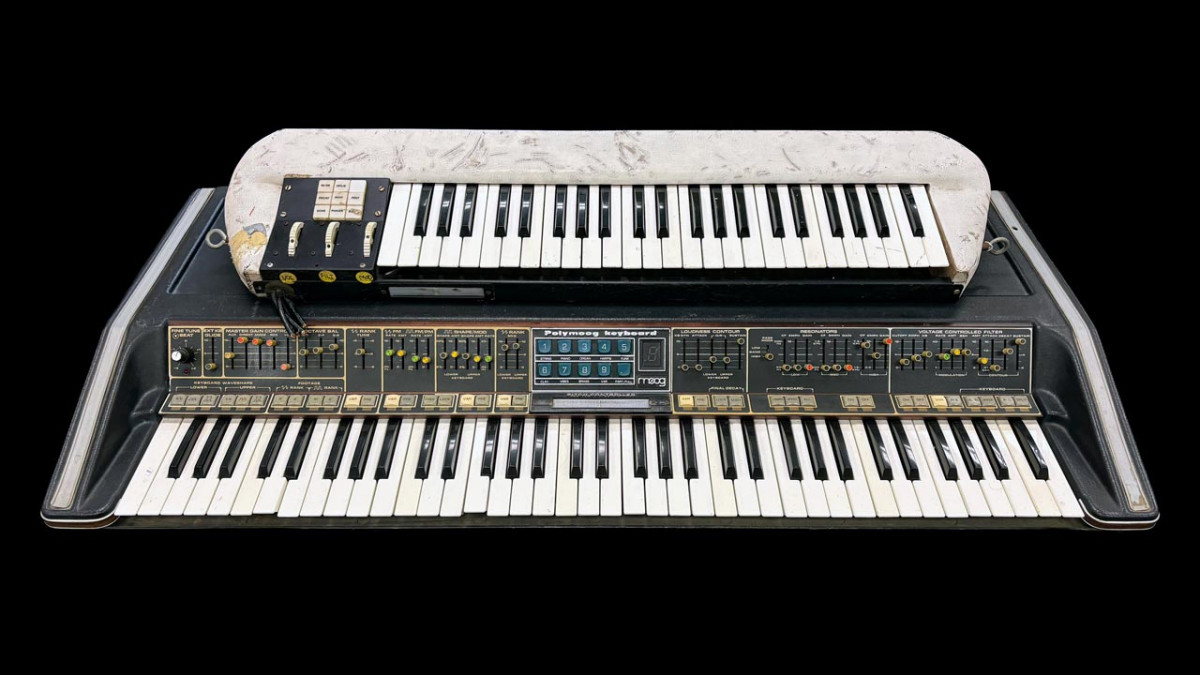
Introduced in 1975, the Polymoog Synthesizer Model 203a was Moog Music's response to the growing demand for fully polyphonic keyboards. Using divide-down technology adapted from electronic organs, it was among the earliest commercially available synthesizers to offer full 71-note polyphony.
The timing couldn't have been better. Throughout the late 1970s, the Polymoog became one of the defining instruments of progressive rock, new wave, art rock, and electronic pop. Its lush string ensembles and expressive textures helped shape the sound of the era, appearing on numerous albums and concert stages. Artists including Gary Numan, Herbie Hancock, Prince, Tony Banks, and Gary Wright all embraced its distinctive voice.
The instrument displayed here has its own remarkable story. This well-traveled Polymoog, along with its custom remote keyboard, belonged to Gary Wright, the musician best known for his 1976 hit Dream Weaver. Wright used these instruments during his live performances to recreate the signature electronic sounds that defined his music.
While the Polymoog is impressive from the outside, what's hidden beneath the lid is just as fascinating. Opening the instrument reveals a dense network of hand-routed wire harnesses, custom circuit boards, and discrete electronic components. Unlike today's keyboards, which pack enormous computing power into a handful of integrated circuits, the Polymoog achieved its capabilities through an intricate assembly of analog electronics.
The custom remote keyboard tells a similar story. Every key is connected by multiple individual wires, which is a striking reminder of the complexity of electronic instrument design before microprocessor-controlled synthesizers became commonplace. Together, these instruments showcase the ingenuity and craftsmanship that defined 1970s electronic engineering.
Today, this particular Polymoog is only partially functional, and its remote keyboard no longer operates. Yet these instruments remain important artifacts from a pivotal moment in music history, when engineers and musicians were discovering entirely new ways to create, perform, and experience electronic music.
Donated by Franz Pusch, in memory of Gary Wright