Contemplating Bridges
From the Executive Director
A bridge connects two places that might not otherwise meet. It does not choose sides. It simply stands, making connection possible.
I often think about the Museum of Making Music in these terms. In fact, I have found myself using the word “bridge” increasingly over the years. It resonates with me. And so, I wanted to pause for a moment to explore why, and to share that reflection with all of you.
Let’s start with our favorite subject. Music.
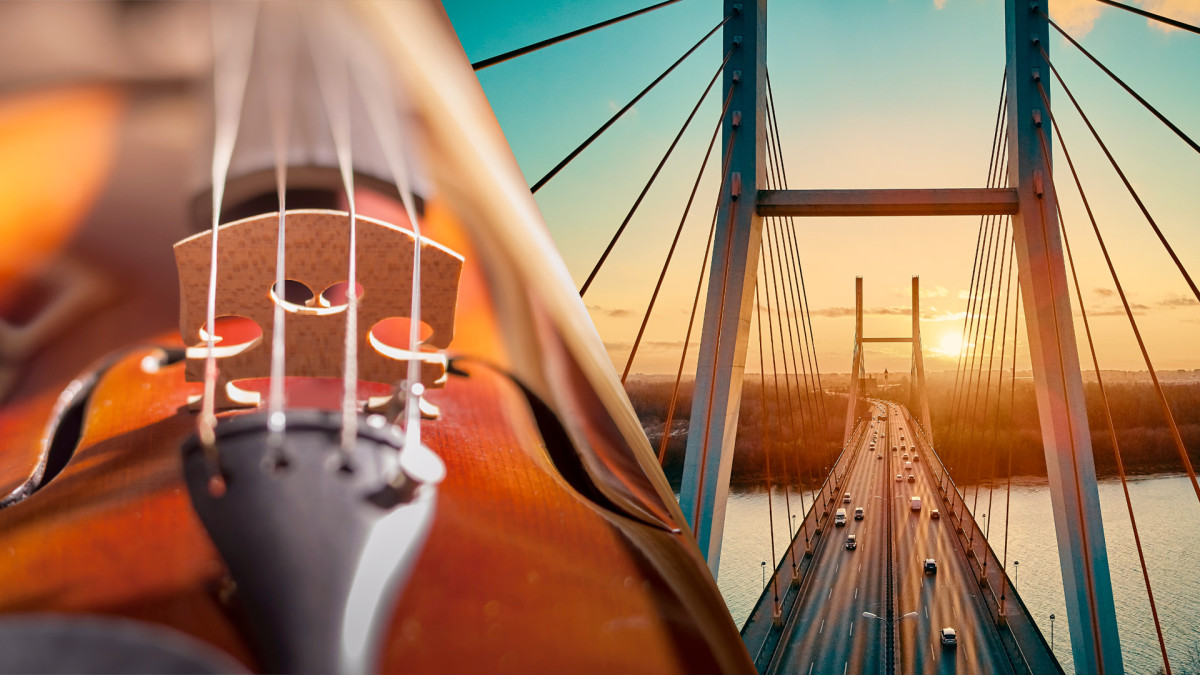
On a stringed instrument, the bridge may appear small and unassuming, yet it is essential. It holds the strings in place and transfers their vibration to the body of the instrument. Without the bridge, there is no resonance. No projection. No voice. It is the quiet mechanism that allows sound to become music.
In compositions, we use the word “bridge” to describe the passage that carries us from one idea to another. We hear contrasting material that deepens the story and signals that something is happening, that a corner is being turned, before leading us home again. And of course, who can hear the phrase without thinking of Bridge Over Troubled Water by Simon & Garfunkel? Beyond simple connection, a bridge implies support and reassurance that someone or something is there to help us cross.
The first time I walked into this museum, it felt as if I had finally found the walkway I had been seeking for several long decades. Before that moment, music seemed far away. It was visible, yes, but blurry and distant. I could make it out somewhat. I could definitely feel its pull. But I had no clear way to approach or reach it. Walking into this museum space felt like finally seeing a crossing emerging from the fog, steady and inviting me forward. It truly felt like a miracle.
After all these years here, I believe this is exactly what the Museum of Making Music strives to be for others. Perhaps we have always done so, and I am simply putting a word to it. In my experience, to name something is to give it power and identity. In doing so, we make it tangible, something we can dismiss or something we can intentionally embrace.
Our unique museum stands at the intersection of a global industry and our local Southern California communities. On one side are the innovators, builders, designers, companies, and visionaries who create and disseminate the tools of human expression. On the other side are individuals searching for their place in the world of music making. Without a bridge between them, those worlds often remain separate. Opportunities are missed. Fulfillment is diminished. But with one, they become interwoven and possibilities expand, richer and more abundant.
Thousands of students encounter music here, sometimes for the first time. And in that moment they see something powerful: that there is a way forward, that a crossing exists. That knowledge stays with them as they move through life. Music is no longer distant. It is a known option. Adults arrive from another vantage point, returning to something once left behind or stepping toward something not yet experienced. They are not striving for virtuosity. They are moving toward connection. Toward expression. Toward community.
Concerts become crossings as well. In those shared evenings, artists and audiences meet in the middle. Stories are carried across the span. Experiences are exchanged. Perspectives are widened. For a few hours, strangers stand together on common ground.
A bridge must be strong and steady. It must be maintained and improved over time. And a bridge does not build itself. It requires vision. It requires hands. It requires commitment. In our case, staff design, build, and reinforce the structure. Volunteers serve as stewards of the span, welcoming others forward. Donors and supporters act as architects of access, ensuring the crossing remains open, stable, and wide enough for all who wish to step onto it. Museum and community members bring the bridge to life through curiosity, participation, and discovery.
And so, this is what we strive to be.
- A bridge that transforms vibration into voice.
- A bridge that turns distance into possibility.
- A bridge strong enough to carry us forward together through music.